Practice notes
A few things you'll meet in class. Have a read, don't worry about memorising anything, and let the practice do the rest.
Before class
- Camera on, always. I need to see you from head to toe on your mat to help with alignment and keep you safe. No camera, no class.
- Set up:
- a mat or folded blanket
- two yoga blocks, or two firm books or a firm cushion
- a quiet corner with room to stretch your arms
- a glass of water
- comfortable clothes
- Eat light: practise on a light stomach. A big lunch followed by Padahastasana is not a great combo.
- Practising together: someone from your household is welcome to practise with you on the same screen, as long as you're both in view.
Om, three times
We begin seated in a comfortable posture: Sukhasana, Ardha Padmasana, Padmasana, Siddhasana or Swastikasana. Sit with the spine tall, the eyes closed and the shoulders soft, and rest the hands on the knees, palms facing up.
Inhale deeply. As you exhale, open the mouth and chant Om in one smooth, continuous sound.
In Sanskrit the "o" is a blend of "a" and "u", which is why Om is also written AUM. So we sound it in three parts:
- aaa, from the back of the throat
- uuu, as the lips round
- mmm, a soft hum with the lips closed
We chant it three times. It can feel a little strange the first time, and by the third Om it usually feels pretty good. Afterwards, sit for a moment and notice the vibration it leaves.
The Mandukya Upanishad describes Om as three sounds, A, U and M, and the silence after them as the fourth.
Opening prayer
Om Saha NavavatuSaha Nau BhunaktuSaha Viryam KaravavahaiTejasvi Navadhitamastu Ma VidvishavahaiOm Shanti Shanti Shantihi
May we both, teacher and student, be protected. May we both be nourished. May we work together with energy. May our study be bright and fruitful. May there be no ill will between us. Om, peace, peace, peace.
Pranayama: breathwork
Pranayama means guiding the breath. In class we usually start with one or two of these. Unless a practice says otherwise, inhale and exhale through the nose.
Yogic breathing. Inhale, and let the belly rise, then the ribs widen, then the upper chest lift a little. Exhale in reverse: chest, ribs, belly. Make it one smooth wave, never forced.
Ujjayi (oo-jai), the breath of victory. Keep the mouth closed and gently narrow the back of the throat, so the breath makes a soft, even sound, like the sea heard from far away. If you feel dizzy, relax the throat and breathe normally. If you have heart disease or high blood pressure, keep it gentle and don't hold the breath.
Nadi Shodhana, alternate nostril breathing. Rest the left hand in Chin mudra. With the right hand in Vishnu mudra, the thumb closes the right nostril and the ring finger closes the left.
- Close the right nostril and inhale through the left.
- Close the left nostril and exhale through the right.
- Inhale through the right.
- Close the right nostril and exhale through the left.
That is one round. Keep the breath soft, almost silent. Rest from this practice when you have a cold, the flu or a fever.
You may also meet:
- Bhramari
- The humming bee breath
- Bhastrika
- The bellows breath
- Kapalabhati
- Short, active exhales through the nose
- Surya Bhedana
- Right-nostril breathing, warming
- Chandra Bhedana
- Left-nostril breathing, cooling
- Sheetali
- Cooling breath through a rolled tongue
- Sheetkari
- Cooling breath through the teeth
Some breathwork isn't suitable during pregnancy, or with high or low blood pressure, heart conditions, epilepsy, hernia or recent surgery. I give the cautions before each practice, so please tell me about any condition before class.
Mudras
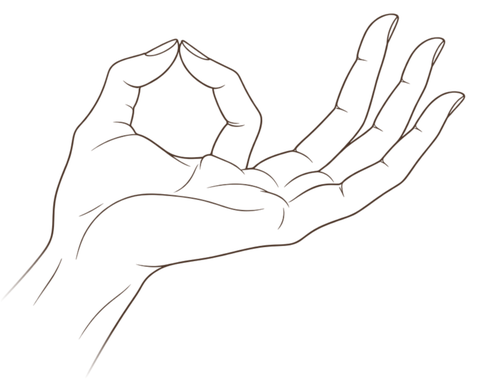
Chin mudra, the gesture of knowledge. Let the tips of the thumb and index finger touch lightly, and keep the other three fingers long. Rest the hands on the thighs or knees, palms facing up.
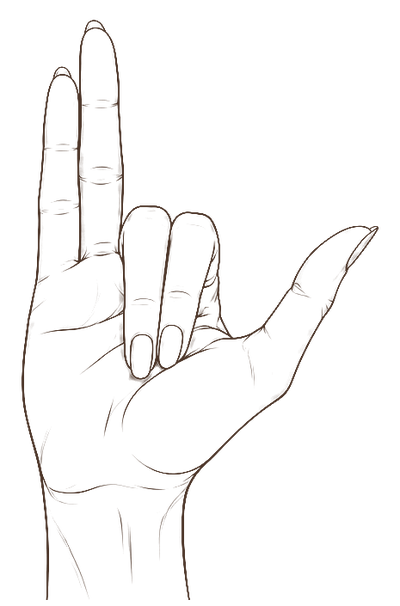
Vishnu mudra. Used in Nadi Shodhana. On the right hand, fold the index and middle fingers in to the base of the thumb, and keep the ring and little fingers straight.
Cooling down
After stronger rounds, such as six rounds of Surya Namaskara, we never go straight to sitting. Walk slowly around your mat with the right hand on the chest and the left hand on the belly. Inhale through the nose and exhale through the mouth until the heart rate settles.
Yoga Nidra and sankalpa
Some classes end with Yoga Nidra, a guided practice that takes you, layer by layer, into deep rest while you stay aware. Yes, you might drift off. It happens to the best of us.
It begins with a sankalpa, a short, heartfelt intention. A sankalpa isn't a resolution to fix yourself. It starts from the understanding that you are already whole.
- How to form it: keep it short, positive and in the present tense, for example "I am at peace" or "I move through life with patience".
- During Yoga Nidra: repeat it quietly to yourself at the beginning and again at the end.
- Afterwards: let it guide your choices through the day.
Closing prayer
Sarve Bhavantu SukhinahSarve Santu NiramayahSarve Bhadrani PashyantuMa Kashchid Duhkha Bhag BhavetOm Shanti Shanti Shantihi
May all be happy. May all be free from illness. May all see what is good. May no one suffer. Om, peace, peace, peace.
Practising safely
Yoga is not a substitute for medical advice or treatment. Please check with your doctor before you begin, especially if you are pregnant, have a health condition, or are recovering from an injury or surgery.
Practise within your own limits, rest whenever you need to, and stop if anything hurts or you feel dizzy. You're responsible for a safe, clear space to practise in. Tell me about any injury or health concern before class.
Learn the names of the postures in the Asana Library.